Adapted and expanded from a guest column by ZoningWorx founder Andrew Gotlieb, originally published in the Cleveland Jewish News.
Most zoning codes in use today were drafted when a “warehouse” meant forklifts and loading docks and an “airport” meant a runway. Today we site buildings that consume the electricity of a small city while employing a few dozen people, and landing pads for aircraft that appear in no use table anywhere in the ordinance.
For a planning commission, that gap is a policy problem. For a lender, a developer, an attorney, or an appraiser, it is a diligence problem — and a more expensive one. When a use has no category of its own, it gets processed under the closest available match. That match is where the risk hides, and it does not show up in a title commitment.
Data centers and drone ports are not a future problem. They are on planning commission agendas now, under codes never written with them in mind. Here is what that means for anyone underwriting, buying, financing, or defending one.
Why “closest match” zoning creates real underwriting risk
A data center is usually processed as industrial or warehouse, because that is the closest match in the code. But the impacts do not line up. Truck traffic — the thing industrial zoning is built to manage — is minimal. What is not minimal is electrical demand, water consumption for cooling, and a continuous 24/7 low-frequency hum punctuated by high-pitched whine.
That hum is why residents call these buildings a nuisance. It is also exactly what a category built around truck trips fails to flag.
When a use is approved under a category that does not describe it, four specific exposures follow:
The approval is thinner than it looks. A use permitted “by right” because it was read into a warehouse definition rests on an administrative interpretation, not an express listing. Interpretations get revisited, and successor staff do not always read the code the same way.
Conditions travel with the property. Where the use is allowed conditionally, the approval typically carries site-specific obligations — setbacks, acoustical studies, cooling design, screening, decommissioning security. Those conditions are enforceable, they bind future owners, and they rarely appear in a standard municipal zoning verification letter.
The code can change underneath the asset. A jurisdiction that adopts a data center definition after a project is approved can leave that project legal nonconforming. Nonconforming status limits expansion, restricts rebuilding after casualty, and can be lost through abandonment — all of which matter to a lender sizing a loan against a single-tenant, single-purpose building.
Reuse is constrained. A 300,000-square-foot building approved as industrial but designed as a data hall is not readily re-tenanted. If the zoning path to an alternate use is narrow, the collateral value assumption behind the loan is narrower than the appraisal suggests.
For the policy side of the same question — what a community gains and gives up by permitting these projects — see our breakdown of the pros and cons of data center zoning.
Communities are responding two ways, and both change your timeline
Some are pausing. Twinsburg City Council passed Ordinance 2026-065 in April, a 12-month moratorium on data center permits while the city studies whether and where to allow the use. Twinsburg is not an outlier: national trackers counted more than 60 local data center moratoriums adopted across the country by mid-2026, with moratorium bills introduced in roughly a dozen state legislatures.
A pause only buys time. Ohio law does not let a city ban a lawful use outright, so the real work is writing standards.
Some are writing standards. Findlay’s proposed ordinance would allow data centers only as a conditional use in a single industrial district, and would require a 1,000-foot setback from homes and schools, an acoustical study, closed-loop cooling, and a decommissioning plan.
None of that is anti-development. It is asking the right questions at the right stage. But it does mean the same use can be by-right in one jurisdiction, conditional with four studies attached in the next, and temporarily unpermittable in a third — with the answer changing between the letter of intent and the closing. ZoningWorx prepares zoning reports in Ohio and nationwide, including in jurisdictions actively rewriting their data center standards.
For diligence purposes, the practical consequence is that a zoning answer more than a few months old is not a zoning answer. Confirm the code in effect on the date of your report, and confirm whether a moratorium, interim control, or pending text amendment is on the calendar.
Drone ports raise a different problem: vertical space
A hub where aircraft store, charge, and launch has a small ground footprint. The impact is overhead, over neighborhoods that were never party to the approval.
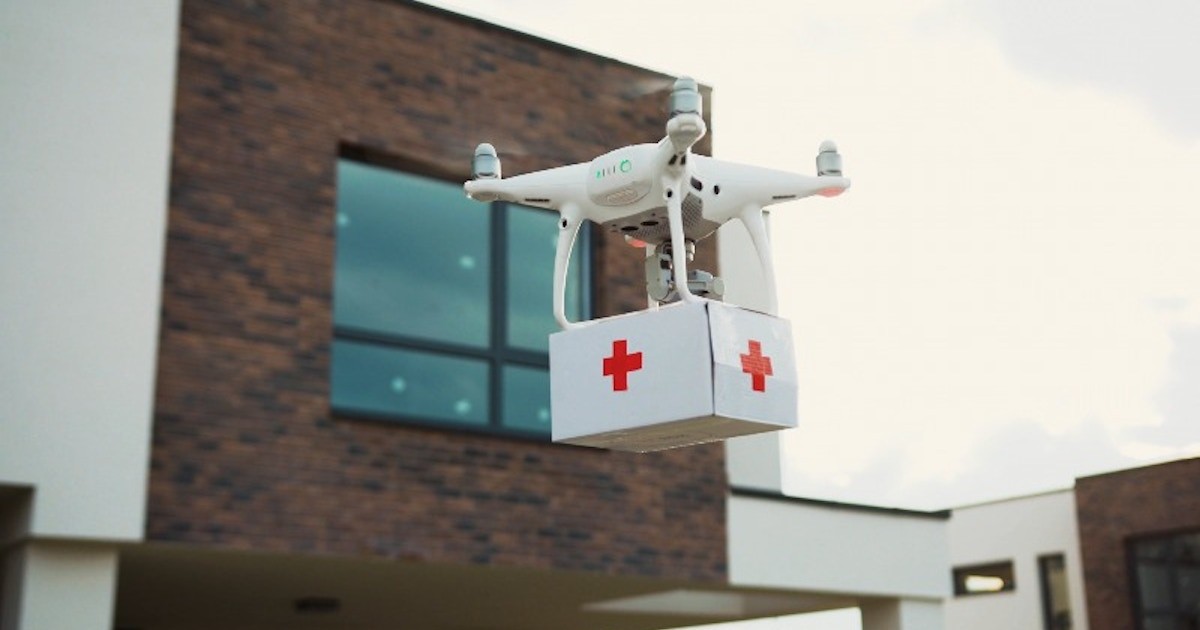
Consider a two-dock Zipline drone station on Science Park Drive in Beachwood, roughly 100 feet from I-271. The planner’s report was straightforward: the site sits in the U-9 motor service district, the pads and tower meet its setback and height limits, and “air space issues are controlled by the FAA.”
A district written for auto service accommodated an aviation facility, and the impact that mattered most fell outside local reach.
This is not hypothetical. In August 2026 Cleveland Clinic began delivering prescriptions by Zipline drone from its Beachwood, Ohio campus — the first long-term drone prescription delivery program run by a U.S. health system — a launch covered nationally on NBC’s TODAY. The land use question arrived first, and it was answered by a district written for motor service.
That split — ground use local, airspace federal — is the diligence trap. A clean municipal sign-off says nothing about whether the operation can actually run as underwritten. FAA authorization, waivers for beyond-visual-line-of-sight operations, and any airspace constraint sit in a separate regulatory track with its own timeline and its own failure modes. A drone logistics facility can be fully zoning-compliant and commercially non-viable at the same time.
Worth noting: Beachwood is no stranger to small aircraft along Interstate 271. It simply hasn’t seen it in more than 30 years, since the Beachwood Radio Airfield operated on Richmond Road — where University Hospitals Ahuja Medical Center stands today.
We have covered how this plays out for Amazon, hospital systems, and the local governments reviewing them in drone ports and zoning codes.
What a zoning report on an emerging use should actually tell you
For conventional product types, a zoning report answers a familiar set of questions: classification, permitted use, setbacks, height, parking, and conformance. For a data center or a drone port, that baseline is necessary but not sufficient. A report worth relying on should also establish:
The exact basis of permission. Not “industrial uses are permitted,” but which listed use the project falls under, whether that reading came from an express definition or a staff interpretation, and whether that interpretation is documented in writing.
Every condition of approval, verbatim. Conditional use permits, variances, development agreements, and PUD ordinances all impose obligations that outlive the original developer. Each one is a covenant your borrower has to satisfy in perpetuity, and each is a default trigger.
Nonconforming status, stated plainly. If the improvements or the use do not conform, the report should say so, cite the provision, and identify what the code permits on expansion, reconstruction after damage, and discontinuance.
Pending legislative activity. Moratoria, interim zoning, comprehensive plan updates, and text amendments under consideration. A property that complies today and is unpermittable in ninety days is a different asset.
What sits outside local jurisdiction. FAA airspace authority, state utility siting and interconnection review, water withdrawal permitting. A zoning report cannot resolve these, but it should tell you clearly that zoning approval does not.
An ALTA zoning report prepared under ALTA Form 3.0 and 3.1 is built to carry exactly this kind of specificity — classification and permitted use under 3.0, and dimensional and parking conformance of the improvements shown on the survey under 3.1. The form is not the limit of what a report can address; the depth of the underlying research is. Our sample zoning reports show how that level of detail is presented.
The practical takeaway
No jurisdiction has this solved. But the choice for a community was never between welcoming these uses and blocking them — it is between categories that fit and ones that do not. A community that defines these uses, sets standards for water, power, noise, and airspace, and says where they belong gives applicants predictability and residents a real voice. One that waits decides anyway, one variance at a time, under deadline.
The parallel for the capital side is direct. A lender or developer who confirms exactly which category a project was approved under, what conditions attached, and what is pending in the code has priced the zoning risk. One who accepts “it’s zoned industrial” has assumed it.
The time to ask is before the commitment letter, not after.
Frequently asked questions
Are data centers permitted in industrial zoning districts?
Often, but by interpretation rather than by name. Most industrial use tables predate the building type and permit data centers as a form of warehouse, utility, or general industrial use. Because the permission rests on how staff read the code rather than an express listing, it should be documented in writing and confirmed against the code currently in effect.
What is a data center moratorium and how does it affect a deal?
A moratorium is a temporary pause on accepting or approving permits for a specified use while a jurisdiction studies whether and where to allow it. National trackers counted more than 60 local data center moratoriums adopted by mid-2026. A moratorium does not usually affect an already-issued permit, but it can halt expansions, phase-two approvals, and any modification requiring new entitlement.
Can a city ban data centers outright?
In Ohio, a municipality generally cannot prohibit a lawful use altogether. What it can do is limit where the use is allowed, require conditional use approval, and impose performance standards on noise, setbacks, cooling, water, and decommissioning.
How is drone port zoning handled?
Ground-level components — pads, storage structures, charging equipment, towers — are reviewed locally against the setback and height standards of whatever district applies, often a district written for an unrelated use. Airspace is controlled by the FAA. Local zoning approval says nothing about whether the flight operation is authorized.
Does an ALTA zoning report cover data centers and drone ports?
Yes. ALTA Form 3.0 and 3.1 reports address zoning classification, permitted use, and dimensional and parking conformance for any property type. For emerging uses, the value depends on how thoroughly the report documents the basis of permission, the conditions of approval, nonconforming status, and pending code changes.
Order a zoning report
ZoningWorx prepares ALTA 3.0 and 3.1 zoning reports and zoning verification letters nationwide for lenders, developers, attorneys, appraisers, and title companies. Reports are Fannie Mae and Freddie Mac accepted and prepared by Certified City Planners and AICP-certified staff. Available 24/7.
Order a zoning report or call (405) 928-9679.
Andrew Gotlieb is founder and director of planning & development at ZoningWorx, a national planning and zoning firm headquartered in Cleveland, Ohio. This article is general information about zoning practice and is not legal advice; consult land use counsel on any specific property.