
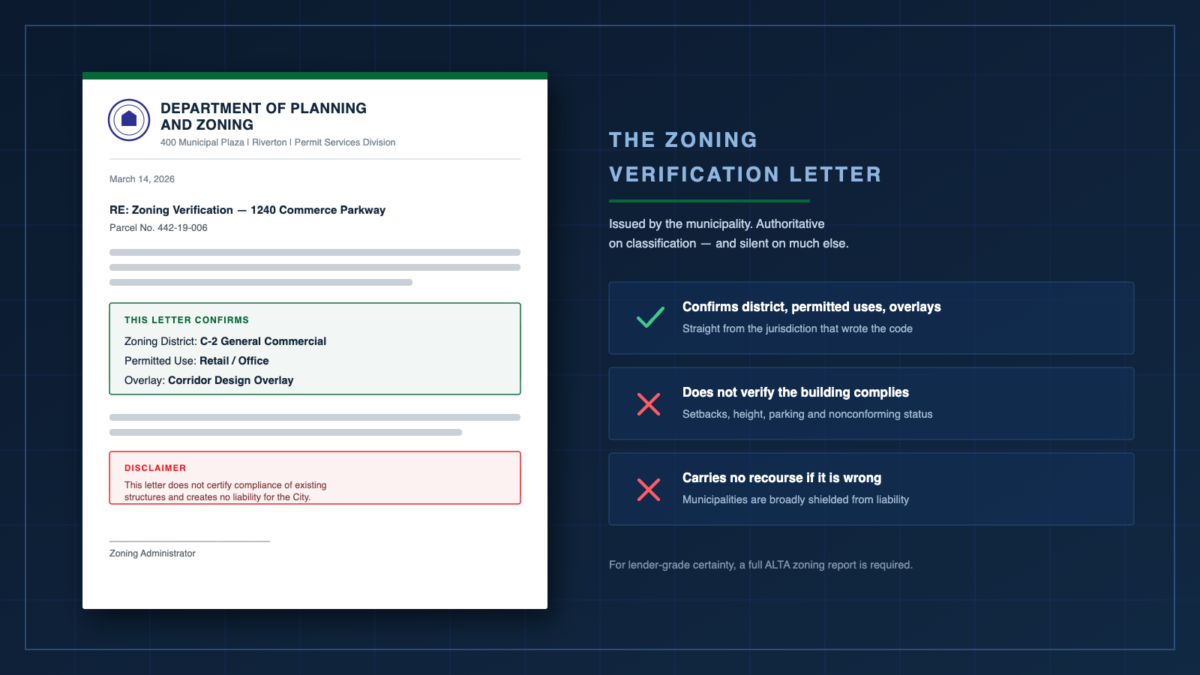
A zoning verification letter and a zoning report both answer questions about zoning, but they do not answer the same questions. The gap between them tends to reveal itself at the worst possible moment: a week before closing, when a lender’s counsel asks something the letter simply does not address.
Both documents have a place, and Zoningworx provides both. But choosing between them on price or turnaround alone is how closings get delayed. Here is what separates them, and how to decide which one your transaction actually requires.
What a Zoning Verification Letter Actually Is
A zoning verification letter — also called a ZVL, zoning letter, or zoning confirmation letter — is issued by the municipality’s planning or zoning department. It is an official statement from the government body that administers the code, and that authority is its main strength.
A typical ZVL confirms:
- Zoning district – the classification applied to the parcel
- Permitted and conditional uses – what the district allows
- Overlay districts – any additional layer of regulation
- Adjacent zoning – classifications on surrounding parcels
- Known violations – open code enforcement matters, in some jurisdictions
What a letter usually does not do is analyze the property. It tells you the rules that apply to the district. It rarely tells you whether the building standing on the parcel today complies with them.
What a Zoning Report Adds
A zoning report starts where the letter stops. It takes the code, the survey, the site plan, and the building itself, then reports whether the improvements conform — setbacks, height, lot coverage, density, parking counts, and legal nonconforming status. It identifies variances, conditional use permits, and site plan approvals of record, and it addresses whether the property could be rebuilt in its current form after a casualty.
It is written to a consistent format regardless of jurisdiction, and it is structured to satisfy American Land Title Association Form 3.0 and 3.1 endorsement requirements. That last point is why lenders and title companies ask for one.
The Liability Difference Most Buyers Miss
Here is the distinction that decides which document a lender will accept. A municipal zoning verification letter is an official statement, but it is generally not something a lender can recover against if it turns out to be wrong. Municipalities are broadly protected from liability for errors in these letters, and many jurisdictions include disclaimer language saying exactly that.
A zoning report from a professional firm is a different instrument:
- Prepared by certified planners – AICP-certified staff reviewing the actual code against the actual property
- Certified to named parties – the lender, title company, or borrower is named and entitled to rely on it
- Backed by insurance – Zoningworx carries $3,000,000 in general liability and E&O coverage, with $1,000,000 in E&O per report
- Consistent nationwide – the same format and scope regardless of jurisdiction
That is not a marketing detail. Underwriting is an exercise in allocating risk, and a document with no recourse behind it allocates all of that risk to the lender.
Right to Rebuild: The Question That Kills Deals
If you take one thing from this post, take this one.
Many income-producing properties are legal nonconforming, meaning they were built lawfully under an older code and are now out of compliance with current setbacks, parking ratios, height limits, or density. That is not a problem while the building stands. It becomes a very large problem if the building burns down.
A lender underwriting a thirty-year loan needs to know which reconstruction rule applies. A zoning verification letter almost never says. A zoning report answers it directly, with the governing code provision cited.
When a Verification Letter Is the Right Call
Plenty of situations call for a letter and nothing more. A ZVL is often sufficient when:
- You need official confirmation of classification for a permit application
- You are testing a use question early in a site search, before committing to full diligence spend
- A municipality specifically requires its own letter for a local approval
- A full report is already complete and a party wants the jurisdiction’s own confirmation on file
The trouble starts when a letter is ordered as a substitute for diligence rather than a component of it. Two constraints are worth knowing before you rely on one:
- Turnaround is unpredictable – municipal response times range from a few business days to a month or more, depending on the department’s backlog
- There is no standard format – what arrives from one jurisdiction may look nothing like what arrives from the next
How Zoningworx Handles Both
Zoningworx obtains zoning verification letters on behalf of clients nationwide, and because we work with planning departments across the country every day, we can often expedite requests through relationships a one-time applicant does not have. We also produce full ALTA-compliant zoning reports that document compliance status, nonconforming use analysis, setback and parking verification, and right-to-rebuild findings in a consistent national format.
For most lenders, attorneys, and title companies, the full report provides the level of documentation actually required for closing, while a standalone letter may leave gaps that surface later in the process. When both are needed, ordering them together avoids a second round of municipal wait time.
Zoning Verification Letters by State
Zoningworx obtains zoning verification letters nationwide, with dedicated coverage in all 50 states and hundreds of individual cities. Select your state below for local coverage details and city-level pages:
Alabama | Alaska | Arizona | Arkansas | California | Colorado | Connecticut | Delaware | Florida | Georgia | Hawaii | Idaho | Illinois | Indiana | Iowa | Kansas | Kentucky | Louisiana | Maine | Maryland | Massachusetts | Michigan | Minnesota | Mississippi | Missouri | Montana | Nebraska | Nevada | New Hampshire | New Jersey | New Mexico | New York | North Carolina | North Dakota | Ohio | Oklahoma | Oregon | Pennsylvania | Rhode Island | South Carolina | South Dakota | Tennessee | Texas | Utah | Vermont | Virginia | Washington | West Virginia | Wisconsin | Wyoming
The Practical Rule
A zoning verification letter tells you what the rules are. A zoning report tells you where your property stands under them, and stands behind the answer.
If money is being lent against the property, if the improvements may be nonconforming, or if anyone will rely on the document to price risk, order the report. If you need a jurisdiction’s own confirmation of classification for a discrete purpose, order the letter. And if you are not certain which applies, that is worth a phone call before it becomes worth a delay.
Before your next closing, order a Zoningworx zoning report to confirm exactly where a property stands, or call (405) 928-9679 to talk through which document your transaction requires. You can also review sample zoning reports to see what a full report includes, or read more about zoning verification letters and ALTA zoning reports for lenders.